
Season 1Episode 2
The Second Watchman
A young man wears the keys to a duty he has not yet learned to feel.
The next tale, by email
One email when a new tale premieres. No noise.
A tale of Responsibility
The keys changed belts in an evening — but the watch itself passed only across a winter of frost, a swallowed shout, and a cold that never left the old man's chest.
About this tale
An old keeper hands the wall to a young watchman who wants its honor but not its cold nights — and cannot bring himself to sleep while the town he guarded all his life rests on unproven hands.
Reflections on this tale
Essay · Responsibility
Four Faces of Responsibility
8 min read · Published 21 September 2026
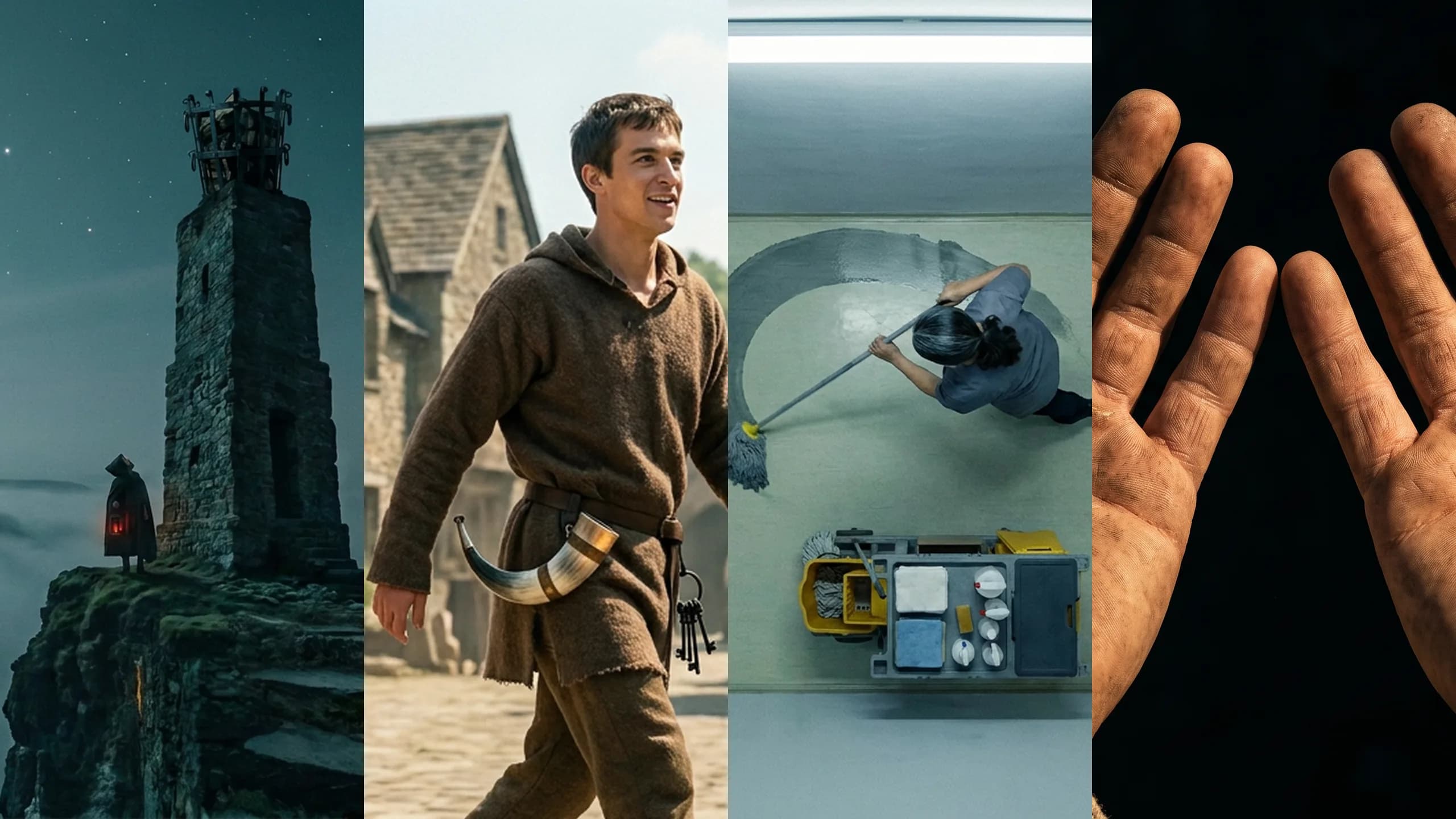
Four tales from the same season, read together as one sequence: watching, handing on, carrying unseen, repairing.

Essay · Responsibility
When Helping Steals the Lesson
6 min read · Published 6 September 2026
Keys pass in an evening. What the old watchman couldn't hand over, he had to watch being learned — one narrow step at a time.
Read the transcript
Forty steps below the wall, in the frost: a line of footprints.
They came in the dark and left before dawn, and the watchman above had walked past them a month without once looking down.
"The Second Watchman" a story about the duty passed down Come closer.
This is a tale of two watchmen an old one, and a young one, and the wall that stood between them.
There was a town in a valley, and above it a wall, and on the wall an old keeper named Aram, who had watched it most of his life.
One autumn night it does not matter now which his watching had saved the town, and the town knew it.
His arm bore the mark of it.
And the council, grateful, had granted what he had asked for: a second watchman, young, to learn the wall.
They sent him Tavik, the potter's son strong on the steps, quick with knots, a boy who could sound the horn so the far farms heard it.
The town loved him on sight.
And here is where the trouble began, for it did not look like trouble at all.
Tavik loved the wall.
He loved the ring of keys on his belt, the horn on its strap, the way the market children ran behind him at noon.
He learned the rounds in a week, and the watch-calls in two.
But at night, on the wall, Aram watched the boy's eyes and the boy's eyes went always to the town, to the lit windows, to the warm side.
Ask him what the night held, and he could name every lamp in the square and nothing at all about the dark beyond the wall.
He wore the keys.
What the keys were for had not yet found him.
Aram tried teaching the way teaching is usually tried.
Lists, rules, the seventy-one steps, the fog-hollows, the place where the ravine narrows.
And the boy learned it all the way one learns a feast-song perfectly, and without weight.
So the old man chose the harder road.
Understand what it cost him, or this is only a story: the wall was his whole life.
And he gave it away.
He told the council his knees were done which was half true hung the full ring of keys on Tavik's belt, and came down the seventy-one steps as keeper for the last time.
That evening he ate his bread alone, in a house that faced away from the wall.
But he did not sleep.
Each night, when the town's lamps went out, Aram wrapped himself in his old cloak, slipped out the small gate, and stood in the ravine below the wall the cold side, the side without one friendly window watching the watcher.
Some nights the boy's lamp moved along the wall like a slow star, and the old man's heart was glad.
Other nights it sat too long near the warm alcove, and Aram stood in the frost with a shout in his throat — and swallowed it.
What does it cost, to swallow a shout?
Call up once, and the wall was his again.
The boy would carry keys forever, and a duty never.
That winter the cold got into his chest.
It never fully left.
Then came the night of the light.
Far on the ridge — small, brief, the kind of flicker a tired eye invents.
Aram saw it from the ravine floor.
And above him, he saw the boy's lamp stop.
Stop, and hold.
Something out in the dark had the boy's eyes now — and it was not the town.
And the old man understood, all at once, the full price of the road he had chosen.
He could not climb.
He could not call.
The town he had guarded most of his life had to rest, tonight, on unproven hands or it would rest on proven ones until those hands were in the grave, and after that on none at all.
The lamp on the wall went dark.
Banked.
And down the outer stair — the cold stair, the one without the town came Tavik, alone, staff in hand, into a dark no one had ordered him into.
He passed within ten paces of the old man and never saw him.
Aram followed far behind, close enough to die beside the boy if the night went wrong, far enough that the night stayed the boy's own.
It was a shepherd fallen among the rocks, a broken lantern, a bad leg, signaling with the last of his oil.
A small night, as nights go.
But Tavik splinted the leg with his own staff and carried the man on his back up the outer stair, where the way up is one man wide.
And near dawn, in the frost by the outer stair, he saw them.
Footprints.
A month of footprints, beside every night he thought he had stood alone.
He came to Aram's door that morning with the whole ring of keys held out in both hands not to give them back.
To ask.
"I know the rounds," he said.
"Teach me what you were looking at."
They walk it together now, some nights slowly, for the old man's chest bread and a little wine on the parapet between rounds.
And some nights the boy walks alone, with an old man's eyes in a young man's face, while the town below sleeps the sleep of the twice-guarded.
One day, you understand, he will hang those keys on someone else's belt.
That is now the wall's true work.
The keys changed belts in one evening.
A key weighs nothing.
What passed in the ravine took a month of frost, a swallowed shout, and the last strong winter of an old man's life.
A duty passes not with the keys, but with the caring.
If this stayed with you, there is another tale that answers it.
Go well.