
The JournalEssay
Four Faces of Responsibility
One keeps a watch nobody sees. Another inherits it before he's ready. A third carries it unseen. A fourth pays for what still broke. Four tales, one shape.
8 min read · Published 21 September 2026

Ask someone who has carried a real responsibility long enough, and the crisis is rarely what they remember first. What stays with them is the ordinary weight of it: the door checked again out of habit rather than alarm, the job explained to a successor who will still be doing it long after the person who taught them is gone, the task nobody will ever confirm was finished, the debt that outlives the apology that was supposed to cover it. Responsibility gets discussed as if it were one virtue, held or not held, present or absent — a single line a person either crosses into or stays outside of. Spend real time near it and a harder question surfaces: what does it actually ask, moment to moment, of a person who takes it seriously? And does it ever ask the same thing twice, or does the shape of the asking keep changing while the word stays the same?
Four unconnected tales, drawn from two very different eras, answer that question the same way without meaning to. Read together, they describe not one job but a sequence: four distinct positions a person occupies inside the same word. There is the one who watches — holding a line long after most people stopped believing it needed holding. There is the one who hands on — passing a duty to someone not yet ready for its full weight, and trusting the trust itself to hold. There is the one who carries it unseen — doing the work for someone who will never know it was ever in question. And there is the one who repairs — the position responsibility lands in once something has already broken, when caring about the outcome stops being enough on its own.
The first position is the watch.

A lone figure climbs a stone stairway inside an old wall at dusk, lamp in hand, because that is what happens at that hour, whether or not anyone below is awake to notice. The particular difficulty of this position is that it produces no evidence of itself while it is working — nothing happening is exactly what a held watch looks like, which makes it the easiest discipline in the world to mistake for unnecessary. The tale that carries this position states its own terms without embellishment: "What you guard in secret guards everyone who sleeps." Held to that line, watching stops looking like an event and starts looking like what it actually is: a cost someone keeps paying on a schedule no one else can see, for people who will never think to ask. But a watch kept by one person cannot go on forever. At some point the only question left is who it passes to — and whether what passes is the role, or something heavier.
The second position is the handoff.

A boy stands at a noon market, a ring of keys and a horn at his belt, children running past behind him — not yet aware that what is being given to him is not the keys at all. An object passes in a single evening; a key weighs nothing in the hand. What must pass alongside it is slower and heavier, and no ceremony completes it in one motion. The tale is exact about the difference: "A duty passes not with the keys, but with the caring." The contrast is the whole position: anyone can be handed the role. Only time, and the willingness to be changed by it, hands over the rest. Yet even a duty successfully passed still has to be carried somewhere no one is checking on it — least of all the very person it exists to protect.
The third position is carried where no one is looking.
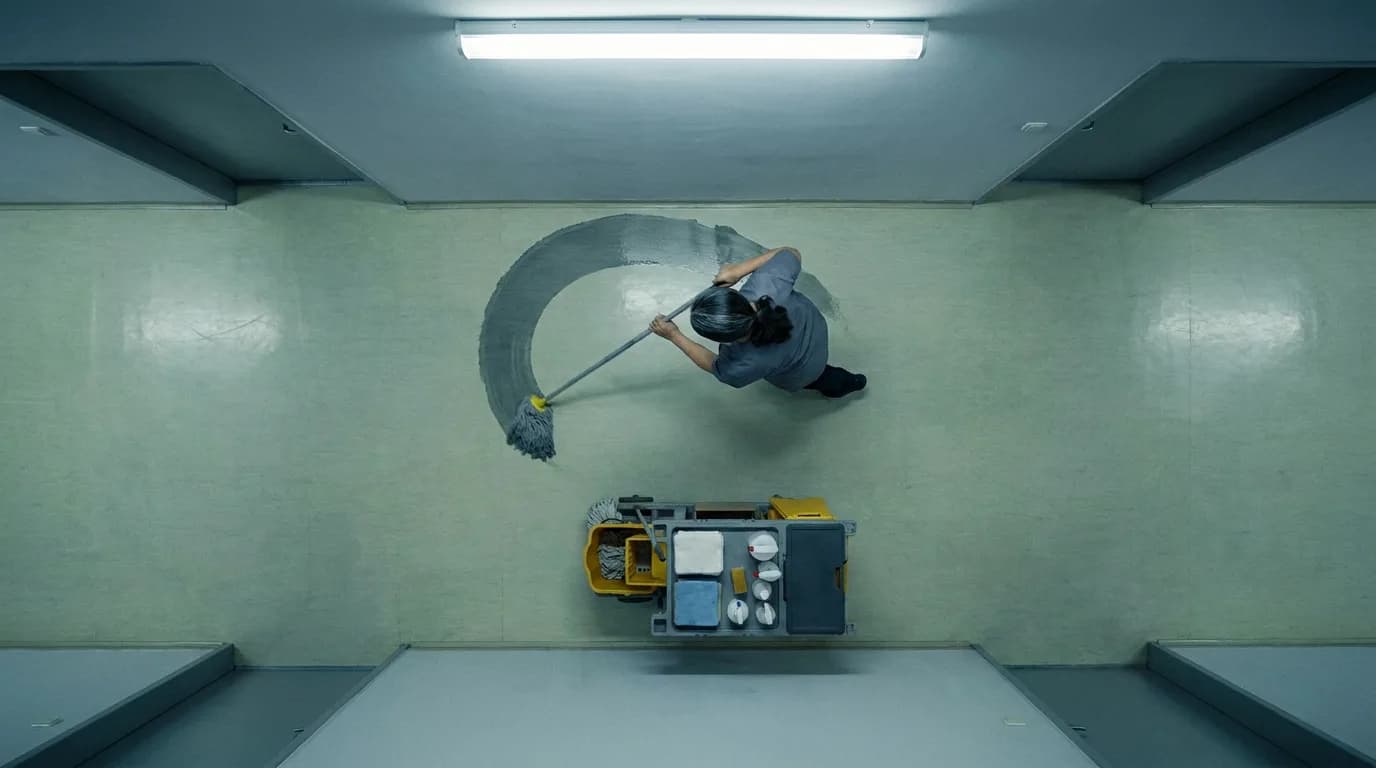
A cleaner works alone on an empty hospital stairwell landing at night, mop in hand, for a stairwell that most people in the building will never once use. There is no one to thank her for it and, more pointedly, no one yet to need it — the entire value of the work sits in a future that has not happened and may never happen to anyone she will ever meet. The tale names exactly what that kind of faithfulness produces, plainly, without asking to be admired for it: "The floor you mop at midnight is somebody's ground to stand on." An ordinary task, repeated long past the point anyone would check it, becomes the one thing solid enough to hold a stranger's full weight, on a night neither of them chose. And even the most faithful unseen carrying cannot guarantee the ground never cracks. Something, eventually, breaks anyway — and then a different question arrives.
The fourth position is the one that answers for what still broke.

An old vinedresser refuses a pouch of coins, hand outstretched but closed, in an ancient vineyard at dusk. Coins are the easy version of an apology — a sum handed over so the matter can be considered finished, the way a sorry is handed over so a feeling can be considered addressed. The tale refuses that shortcut on the same terms it refuses the coins: "You have not owned a fault until you have paid for its repair." Not the feeling, and not even the confession, but the repair itself, carried out and paid for in full, is the only accounting this position recognizes as real.
None of these four positions is a one-time event, in the tale that holds it or in a life spent reading about it. The watch does not retire once it succeeds — it only feels retired, right up until it is needed again, and the feeling is not evidence. The handoff does not finish the moment an object changes hands — the caring keeps arriving, in installments, long after the object itself stopped meaning anything to either party. The unseen work does not stop producing value once a shift ends; it simply waits, unclaimed, for the night someone finally needs the ground it built, which may be years away or may never come at all. And the repair, once made, does not undo the fact that repair was required — it only proves the person was capable of being trusted with the next thing that breaks, which is a different kind of proof than innocence would have been. Responsibility, read this way, is less a trait a person has than a rotation they keep entering — and if you have lived any real length of adult life, the odds are you have already stood in more than one of these four positions, usually without being asked, and rarely on a schedule anyone would have chosen. The four tales do not overlap in character or place, but the sequence they trace — watch, hand on, carry unseen, repair — is the same sequence a single ordinary life tends to move through more than once, sometimes within the same year.
Three of these four tales are set in an unnamed ancient past — a walled town, a market at noon, a vineyard at dusk — and one is set now, in a hospital stairwell that could belong to this year. What is worth noting honestly is what does not change across that gap: none of the four positions reads as older or newer than the others, or as belonging more to one era than another. A hospital did not exist when the other three tales are set, and a walled town does not exist for most readers now, yet the felt shape of watching, handing on, carrying unseen, and repairing translates across that gap without needing a footnote. The watch, the handoff, the unseen carrying, and the repair look less like a custom that happened to survive from an earlier age than like a fixed shape human responsibility keeps taking, regardless of the century assigned to it.
There is a harder truth this small set of four tales has not yet told, and it is worth naming rather than smoothing over. In every one of these four positions, what has been shown so far is what happens when the position fails by absence — someone who should have watched, handed on, carried, or repaired, and didn't. What has not yet been shown is the opposite failure, the one that can look like virtue right up until it isn't: responsibility carried past the point where it was still doing anyone any good, a watch that never learns to stand down, a carrying that refuses to be handed off even once someone capable is finally ready for it, a repair that keeps being made long after the debt was settled because stopping has started to feel like abandonment. That failure is quieter than the first kind and harder to name from inside it, which may be exactly why this small set of tales has not told it yet. It is owed, not answered, and naming the debt honestly is more useful than pretending the shape already on the page is the whole shape.
This small set holds four positions so far, out of a season built to hold many more. The watch, the handoff, the carrying no one sees, and the repair form one throughline running under four tales that share no character, no place, and in three of four cases, not even a century. It is not the whole shape of what this season has to say about responsibility, only what is visible so far from four vantage points out of many still to come.
The tales themselves — The Keeper of the Wall, The Second Watchman, The Night Shift, and The Debt of the Vineyard — are gathered, with the rest of the season, on the responsibility page. New episodes continue the sequence as they air; the mailing list carries word of each one.

Watch the tale this pattern comes from
The Keeper of the Wall
Season 1 · Episode 1Watch now →


The next tale or reflection, by email
One email when a new tale or reflection is ready. No noise.
Questions
- What does responsibility actually mean?
- Not one virtue a person either has or lacks. Spend real time near it and it turns out to ask something specific, moment to moment, of whoever takes it seriously — and to keep asking, since it works less like a trait a person holds than a rotation they keep entering.
- What are the different kinds of responsibility a person takes on?
- Four distinct positions inside the same word: the one who watches, the one who hands on a duty not yet fully understood, the one who carries it unseen, and the one who repairs once something has already broken.
- What responsibilities come with being an adult?
- If you've lived any real length of adult life, you've likely already stood in more than one of these four positions — watching, handing on, carrying unseen, or repairing — usually without being asked, and rarely on a schedule you would have chosen.