
The JournalEssay
The Future Cannot Thank You
A station gardener keeps dying seeds alive for people who don't exist yet — and who could never, in any world, thank her for it.
8 min read · Published 9 October 2026
Some kinds of care will never be repaid, witnessed, or even acknowledged — not later, not posthumously, not in any form a grateful word or a returned favor could take. This is a different problem from going unnoticed. An unnoticed kindness can, in principle, still be seen; a debt nobody has gotten around to repaying can, in principle, still be paid. What follows is about a harder case: care given to someone who does not yet exist to receive it, and who therefore cannot, even in principle, enter into any exchange with the person who gave it. No witness is coming. No thanks is overdue. The absence is not an oversight anyone could correct later — it is built into the shape of the gift itself. Most advice about working for the future quietly assumes a receiver is merely delayed. This is about the case where there is no receiver to delay.
Call the ordinary kind of exchange reciprocity, and define it plainly: two parties capable, in principle, of trading places — the giver could someday need, and the receiver could someday give back. Going unseen is an evidence problem inside that structure; the good was real, a witness simply wasn't looking. Stewardship for people who are not yet born breaks the structure itself, at the root, not at the edges. There is no one on the other end of the ledger, not now, not within the giver's own lifetime, and no amount of future looking will change that arithmetic.
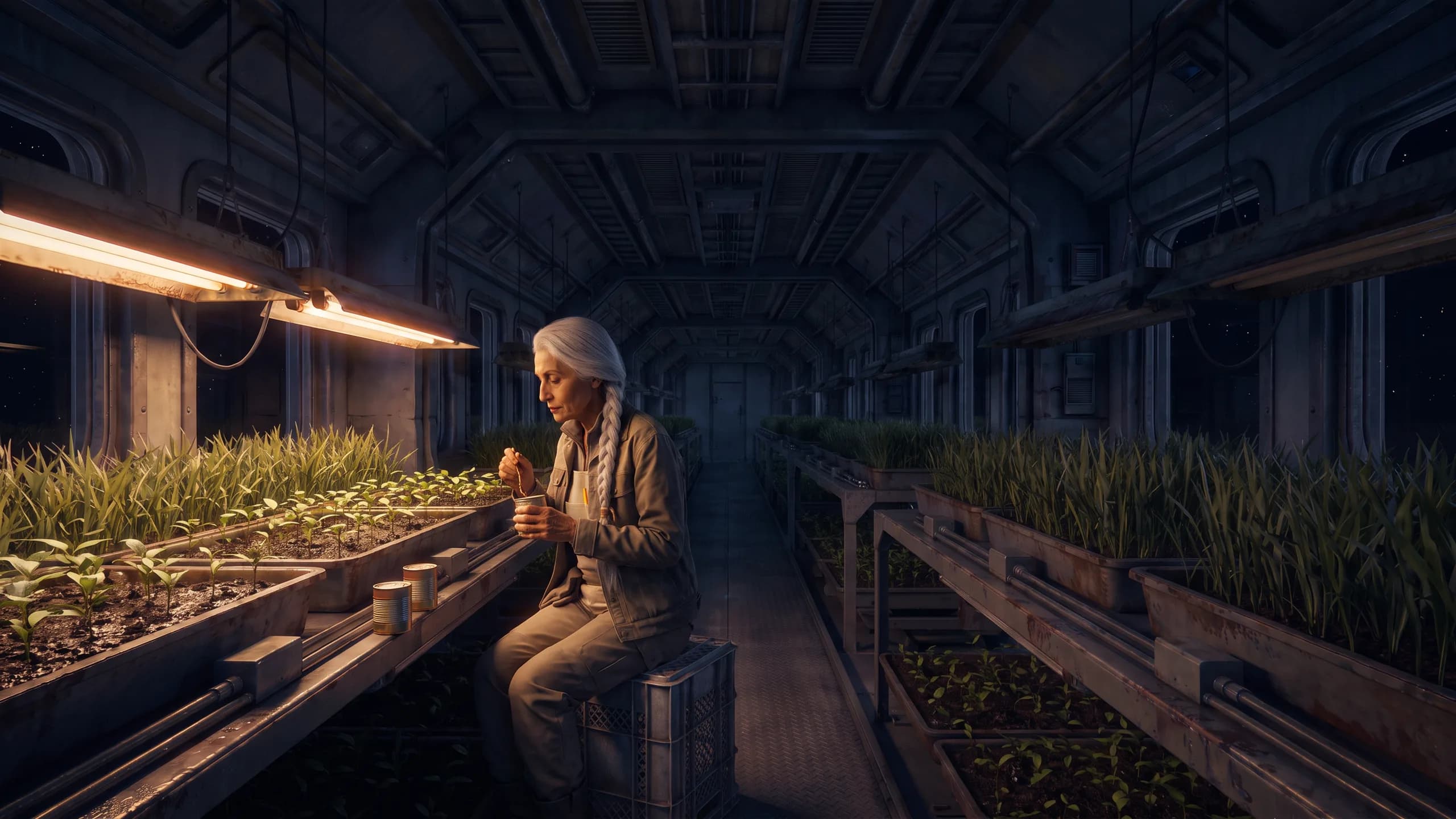
An old story, already told in full elsewhere, makes the shape of this visible in a single setting. High above a world gone winter, a station keeps drawer upon drawer of sleeping seeds — wheat from a valley now under the sea, beans from a plain that burned, whole orchards folded down to a handful of stones. An old woman named Tamar tends them, dirt under her nails, gloves worn through at the thumb, a cup of tea forever going cold on the bench beside her because the work never quite leaves room to drink it. Her work holds a secret most people never learn: seeds sleep, but not forever. Each kind must be woken, grown out, and laid back down, or the drawer becomes, in the story's own phrase, a box of dust with a beautiful label — the record of a thing, long after the thing itself has stopped being true.
One ordinary day, word comes up from the people the vault answers to, below. The station is to be thinned, the growing ring powered down. "Storage is sufficient," the message reads. "The cold keeps them. Growing is sentiment." Tamar reads it twice, then checks her own ledgers, where the truth sits plainer than any memo: the drowned valley's wheat is failing in its sleep, a little faster with every season it goes unwoken — and if it isn't grown out soon, a season or two at most, it will not wake again at all. The cold keeps nothing, she concludes. The cold only slows the losing.
Nothing about that memo is cruel, and nothing about it is stupid. It is what any accounting system produces when it can only track debts someone alive can collect. The growing ring draws real power today, on a real schedule; the harm of letting a valley's wheat die in its sleep lands on nobody who could file a complaint, because the people it would have fed are decades, maybe generations, from being born. Whoever wrote that memo was not being lazy or dishonest; they were reading a ledger exactly as a ledger is built to be read, and the ledger simply has no column for a harvest no one currently alive will eat. A system built to see only returns a living person can book will always read uncollectible care as waste — not through malice, but because waste and uncollectible value produce, on the same ledger, the identical line: a cost with nothing legible written on the other side of it.
Held up against an ordinary sense of fairness, that structural blindness breaks into three familiar mistakes, and knowing which one is in play is most of the work of answering it. The first is plain absence: deciding that because no thanks is coming, the keeping isn't worth doing — the charter's own position, in large, and in miniature the same reasoning anyone uses to quietly let go of some unthanked maintenance nobody will ever credit them for. The second sits closer to excess: needing the thanks so much that its absence starts to feel like an injury, as though a debt were actually owed and simply withheld; most of us, if honest, keep some version of this private ledger running even for strangers who never asked us to keep it. The third is the counterfeit, and it is the one that wears virtue's own clothes: doing the unthanked work anyway, but secretly for the thanks that might arrive after death — to be remembered, to have a name attached, to be the quiet subject of some future stranger's gratitude. The story is careful never to let its own keeper have this. No one below knew her name, it notes early, least of all the ones she was working for. Taking care out of reciprocity has to mean taking it out of the delayed, posthumous kind as well; a stewardship that quietly plans for future credit has not solved the problem it claims to answer, only moved the bill to an account it still, secretly, expects to collect from.
What this costs in practice is not abstract, and the same story that states the claim also prices it. Tamar gives up her one certain way home, then gives up her own warmth — carrying trays of wakened wheat into the single room the station can still heat, and spending six cold weeks in the corridor outside her own door so the harvest will live. She will not see the valley replanted, the telling says, flatly, as a fact it finds good rather than bitter. No one now living will. That is the honest cost of taking reciprocity fully off the table: not only no thanks, but no proof within a lifetime that any of it mattered to anyone.
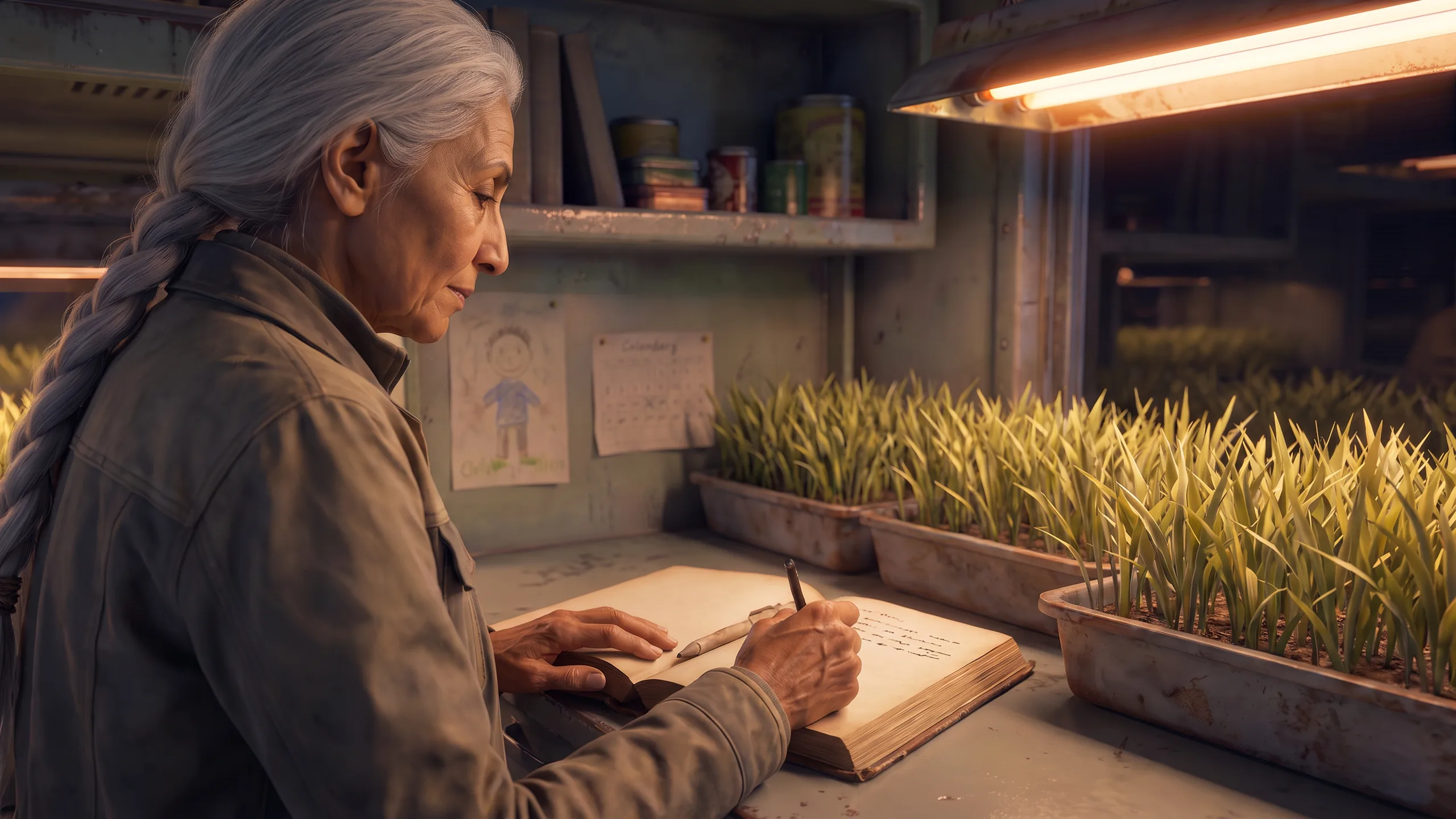
What replaces the thanks, in the story's own quiet answer, are two concrete things, neither one quite a comfort. The first is a record — ledgers kept faithfully enough that someone, eventually, has to admit the growing was working all along. The second is a blessing: a second ledger, begun the week the charter is renewed, addressed to whoever eventually plants what she has kept alive — a letter to a planter she will never meet, for a field that does not exist yet. "Give it a wide sky," she writes, of wheat that leans hard toward the morning light. Love, addressed, with no address to send it to.
None of this is unique to orbital stations or drowned valleys. A grandparent plants a fruit tree that will not bear anything worth eating for twenty years, fully aware of whose teeth will actually use it. Someone leaving a job writes a decision log explaining a choice that nobody currently on the team will ever need — for whoever eventually inherits the system, not yet hired when the log was written. A parent writes a letter meant for a grandchild who has not been conceived, trusting an envelope to outlast an idea, and a committee drafts rules for an institution's hundredth year knowing none of them will be in the room to see whether the rules held. Nearly every culture seems to keep some version of the same old proverb, about a tree planted for shade its planter will never sit in — less a sentiment, on inspection, than an accurate description of one very specific kind of labor: labor that can only be finished by someone who is not yet a person.
If you have ever kept something running — a tradition, a skill, a habit, a piece of software, a garden — for the sake of someone who will only ever meet the result, you already know the shape of this without needing a story to name it. The thanks you are owed for that kind of keeping is not late. It was never coming, and it was never, in the end, what the keeping was for.
The claim has a real limit, and it is worth naming so the whole thing does not curdle into an excuse. Not every unthanked effort is this virtue. Someone who refuses the gratitude available from people who are actually present — who hides behind not needing thanks while ignoring the people standing in front of them, fully capable of thanking them right now — is not practicing stewardship for the unborn. That is a smaller, lesser thing: using a future nobody can check as cover for a present somebody could, and it costs nothing to perform, which is exactly how to recognize it. Real stewardship for hands not yet born does not compete with the people already in the room; it only begins once every debt that could actually be collected has been set aside on purpose, not avoided by accident.
The thank-you was never coming. What stands in for it, when the work is done honestly, is a record that outlives the feeling, and a blessing that does not need an address to be real.
The cold only slows the losing.
Watch the tale this pattern comes from — The Orbital Gardener, S01E05.

Watch the tale this pattern comes from
The Orbital Gardener
Season 1 · Episode 5Watch now →
The next tale or reflection, by email
One email when a new tale or reflection is ready. No noise.
Questions
- What does the proverb about old men planting trees they will never sit under mean?
- It describes labor that can only be finished by someone who is not yet a person — care given with no possibility, even in principle, of the giver ever being thanked for it by the one it was for.
- Why do people plant trees they will never sit under?
- Because the shade isn't for them. It is a finished gift paid forward to someone who does not exist yet to say thank you for it — which runs on a different motive than most effort, since the usual cure for going unthanked, eventual recognition, is not available even in principle.