
The JournalEssay
Somebody's Ground to Stand On
Someone is keeping ground for you that you will never see and never thank them for — and that quiet, unassigned care is what an ordinary life actually stands on.
5 min read · Published 6 September 2026

Somewhere tonight, in some building far from here, someone is keeping ground ready for a person she will never meet: a door freed that used to stick, a bulb steadied that used to gutter. She was never introduced to him. She never will be. The real question is why so few of us ever think to ask who keeps the ground a life we didn't build is standing on.
There is an old story built around exactly this shape: a hospital, and in it, at night, a cleaner named Rosa, who cleaned what the list said, then, on her own break, cleaned one thing more — the old east stairwell the list had forgotten years ago. Nobody had assigned it to her. This has a name: unseen faithfulness as care for a stranger, kept for someone who will never know it was kept.

Her sister put the reasonable case to her plainly: let it go. Who sees? Nobody, said Rosa. Both halves of that exchange are true, in their way. Nobody was checking the east stairwell, and nothing in her contract required her to be the one who did. That is the comfortable half of the pattern. The discipline runs the other way, and it is worth naming just as plainly: keeping ground for a person who has no face yet, and may never have one, is not a debt anyone is owed. It is a debt someone decides to carry anyway. The parallels are everywhere once absence of danger stops being mistaken for absence of duty: the stranger who keeps a spare inhaler in a drawer for a child at a school she has never set foot in; the volunteer who tests a well's water twice a year though she drinks from a tap across town; the hallway kit someone keeps stocked, checked, and untouched for a year, for an emergency that has not happened yet and might never happen on that particular floor. None of them can name who, specifically, they are keeping the ground for. Nobody needs them to. A debt owed to no one in particular is still a debt — it simply never comes due with a name attached, or a thank-you at the end.
The failure runs both directions, and the second one deserves naming just as plainly: care that never lets itself be shared is not more devoted than care that rests when rest is earned — it is a different way of losing the thread, mistaking exhaustion for virtue and refusing the relief of another pair of hands. Ground kept alone forever eventually goes untended by accident, the day the one keeper finally has to stop, and no one else knows where the weak hinge was. The stronger discipline is the one that can hand the ground to someone else without ever letting go of it — that can teach the failure points by name instead of guarding them like a secret.
Care like this looks like nothing from outside, because there is no relationship for it to show up in — no face to thank, no name to remember, nothing exchanged that either side would recognize as a gift. It differs, in this one way, from almost every other kind of quiet care this pattern gets compared to: even someone tending a sleeping parent, or a parent checking a stove twice after everyone else is asleep, is caring for a person who will eventually know. Care for a total stranger has no such horizon. That is exactly its cost. It offers no bond to sustain it and no witness to notice if it stopped, which is precisely why it is the easiest kind of care in the world to quietly let go.
Here is the reframe the tale is actually making, once the scene is set down: the stairwell belonged to no one, and that was never the same as belonging to nobody. "The stairs belonged to no one," the story says. "Which is how she knew, by now, exactly whose they were." Ownerless ground is not unclaimed ground. It is ground somebody has to decide to claim, precisely because no one else will.
That is worth carrying past the tale itself: what ground is being kept right now, unpaid, unmet, and unthanked, for a life you have never once thought to ask about?

The reframe the tale makes is not resolved so much as proven: the ground kept faithfully for years becomes, on one ordinary night, the exact ground someone else's rescue has to run across. No one plans for that convergence. No one can. The keeping has to happen long before there is any way to know it will ever matter to anyone at all — which means it has to happen on every ordinary night that isn't the one that counts, for years, on the strength of nothing but the decision to keep counting it as ground worth keeping.
The tale that carries this pattern all the way through is called The Night Shift.
The floor you mop at midnight is somebody's ground to stand on.

Which brings the building back around: the same door, freed and holding; the same bulb, steadied and warm; a corridor kept clear tonight for a person who does not exist yet, as far as anyone there is concerned. No one will log the freed door or the steadied bulb. No one will ask why they're fine. That is not the absence of the care. That is the care, working exactly as it was meant to: unpaid, unmet, and — until now — unnoticed.
Watch the tale this pattern comes from — The Night Shift, S01E03.

Watch the tale this pattern comes from
The Night Shift
Season 1 · Episode 3Watch now →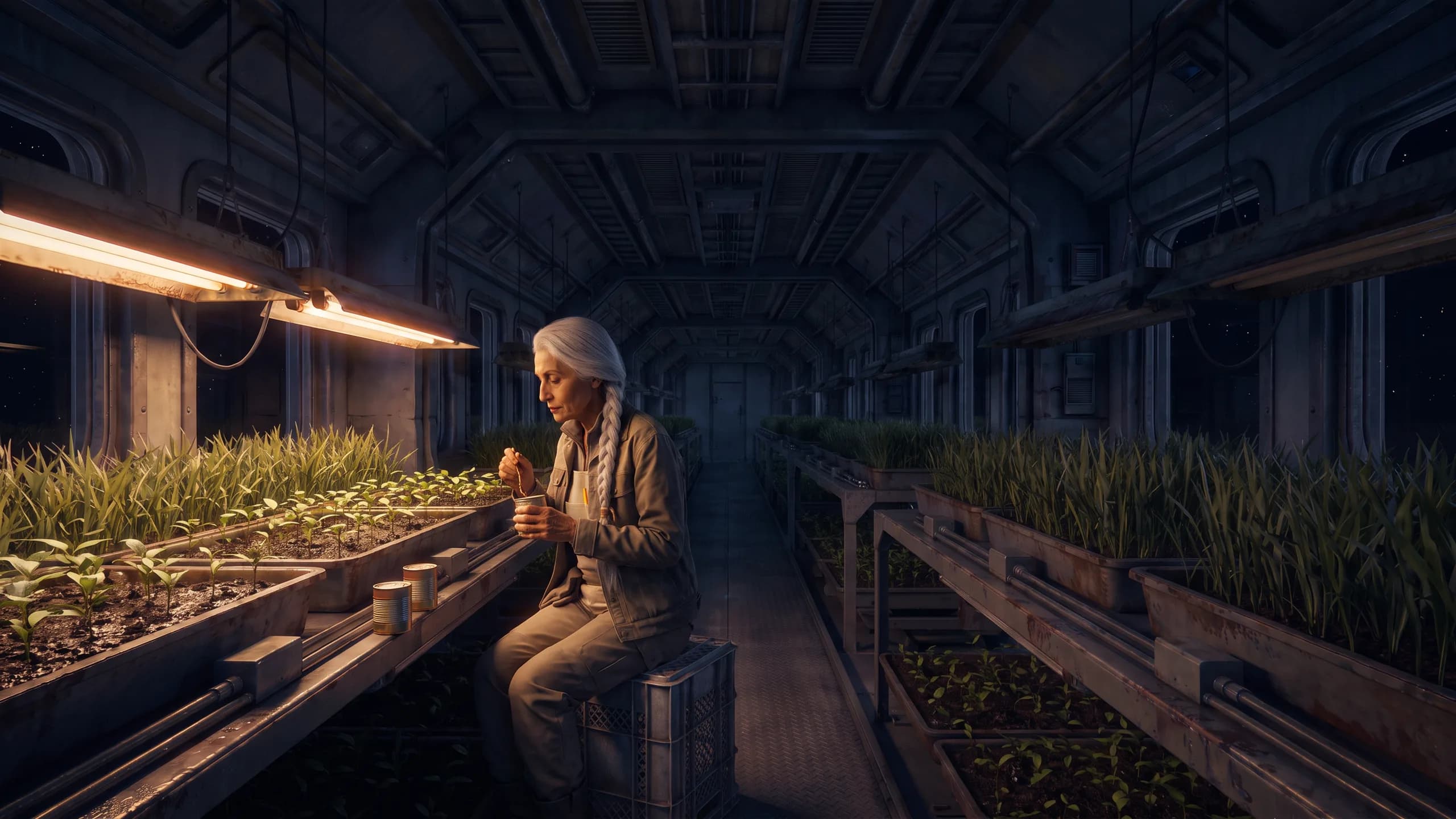


The next tale or reflection, by email
One email when a new tale or reflection is ready. No noise.
Questions
- Why do people care for strangers they will never meet?
- Because ownerless ground still needs keeping. A debt owed to no one in particular is still a debt — someone decides to carry it anyway, knowing it never comes due with a name attached, or a thank-you at the end.
- What makes caring for a stranger harder than other quiet care?
- It has no horizon: no face to thank, no bond to sustain it, no witness to notice if it stopped. Even tending a sleeping parent is care for someone who will eventually know. That is exactly why it is the easiest care in the world to quietly let go.
- If ground belongs to no one, whose job is it to keep it?
- The story's own answer: belonging to no one was never the same as belonging to nobody. Ownerless ground is ground somebody has to decide to claim — precisely because no one else will.