
Season 1Episode 5
The Orbital Gardener
A solar storm leaves heat for only one room; a gardener must choose who keeps it.
The next tale, by email
One email when a new tale premieres. No noise.
A tale of Responsibility
She kept nothing for herself in the end — not the ferry home, not the warm room, not even a name the wheat would remember. What she gave went to a valley she will never see and hands she will never know.
About this tale
A station gardener gives up her last ferry home to keep a valley's failing seeds alive — then a solar storm leaves heat for only one room, and the harvest she may never see finished hangs on what she does next.
Reflections on this tale
Read the transcript
She had one warm room left on a station built for forty, and she gave it to the wheat.
No one below knew her name least of all the ones she was working for.
“The Orbital Gardener” A story about planting for hands not yet born.
Come closer.
This one has not happened yet or it is happening now, far over your head, while you listen.
There was a station, high above a world gone winter, built to keep seeds.
Drawer upon drawer of them, a hall of sleeping fields: wheat from a valley now under the sea, beans from a plain that burned, whole orchards folded down to a handful of stones.
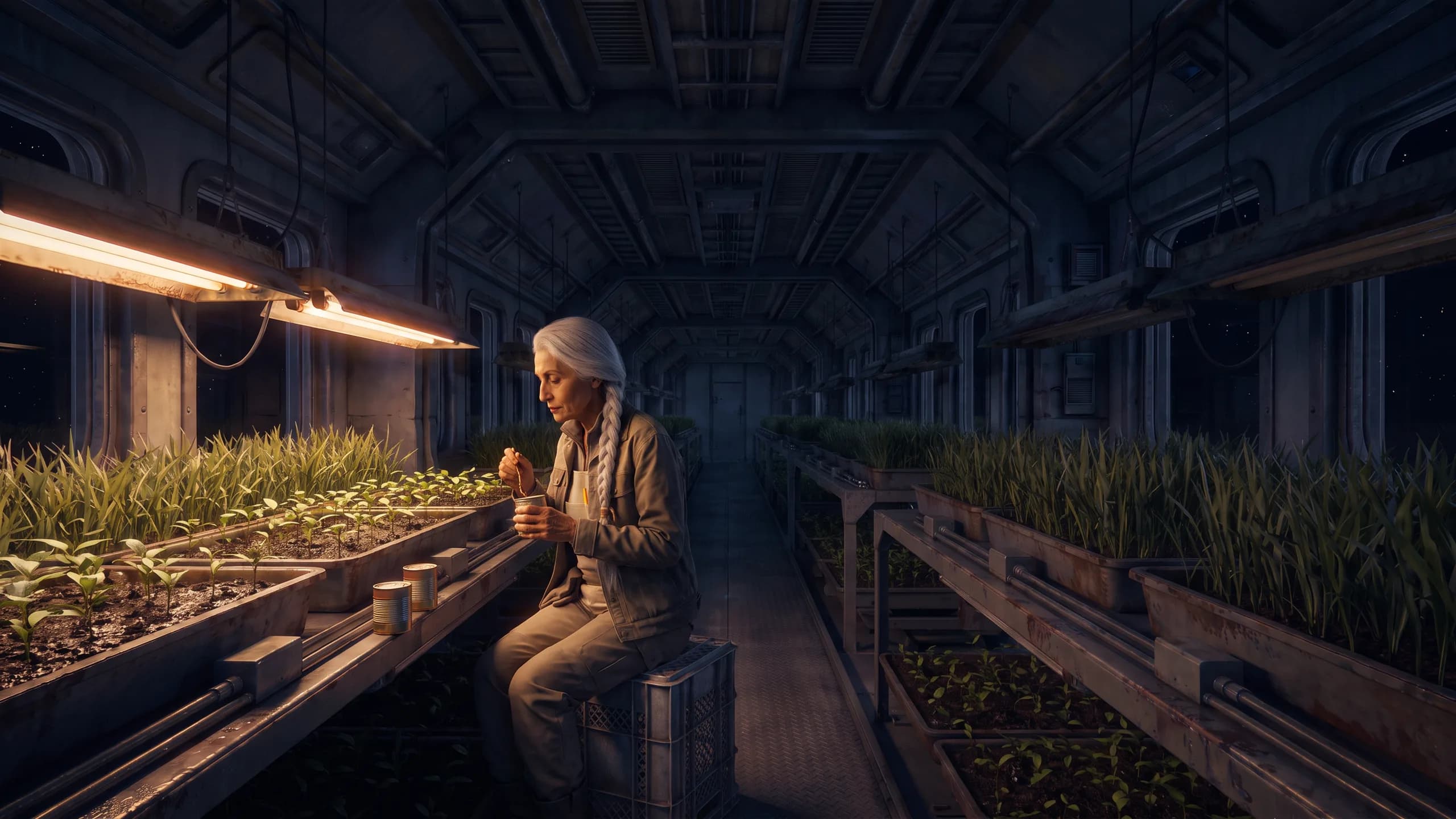
And the station had a gardener an old woman named Tamar, with dirt under her nails; gloves worn through at the thumb, and a cup of tea forever going cold on the bench beside her.
Her work was a secret most people never learn: seeds sleep, but they do not sleep forever.
Each kind must be woken now and then grown out in the ring garden, brought to fresh seed, laid back down — or the drawer becomes a box of dust with a beautiful label.
The word came up from below on an ordinary day: the station was to be thinned.
The crews cut, the growing ring powered down.
Storage is sufficient, the message said.
The cold keeps them.
Growing is sentiment.
Tamar read it twice, then went to her ledgers.
And there it was, running down the page the count of the woken, thinning year by year, quiet as dust settling.
The drowned valley's wheat was failing in its sleep, fewer seeds waking with every test, and the failing was gathering speed.
If it was not grown out soon a season, two at the most it would not wake at all.
The cold keeps nothing.
The cold only slows the losing.
The last full ferry home had a berth with her name on it.
Down there was her sister, growing old in a house with a garden; a grandniece she knew mostly as a voice, brighter every year; the good years she had left, and somewhere green to spend them.
She wrote her name off the list.
One line, in her own hand and the longest sentence of her life.
The ferry fell away below her window like a dropped coin, and the station went quiet around her, and she put on her gloves and went to wake the wheat.
On quarter-power she grew the failing kinds out one by one, and she was very good at it, and it was very hard.
She knew the valley wheat wanted long light and lean water; she knew the plains bean wanted its nights cold as a cellar.
She labeled every tray in grease pencil, ate from the same three tins, and spoke to no one for weeks but the hum of the air.
Some drawers woke for her.
Some did not.
She sat one whole evening beside a tray of soil that stayed as still as it began — the last of an orchard nobody living had tasted.
There is a tiredness in keeping things no one asks about.
Then the sun turned bad.
A storm off the sun, the long kind, and the station folded itself small to survive it power drawn in to the core, module after module going dark and cold.
The vault itself would hold; deep cold is what a sleeping seed wants.
But the ring stood full of wakened wheat, green and half-grown, a whole season of it — and a green thing that freezes dies in a night.
The station had heat left for one room.
Hers.
And Tamar understood the price of the ledger she had signed her life to: keeping, in the end, is paid for out of your own warmth.
She carried the trays down the dark spine of the station — forty trips, her breath hanging in the corridors and filled her one warm room with wheat.
Lamps hung from the bunk frame.
Green blades where her blanket should have been.
For six weeks she lived in the corridor outside her own door, in every jacket she owned, sleeping curled like a shepherd at the fold.
Her hands went stiff.
Two fingers took a frost-mark she would carry from then on.
Each morning she stood up aching, opened the door on that small green room blazing with light, and counted the stalks.
The storm passed.
The wheat stood.
She harvested seed in her own bedroom, and laid the drowned valley's drawer down fuller than any keeper had ever found it.
Her ledgers went down with the next courier load year upon year of them, the proof that the drawers were alive because one gardener had kept waking them.
And months later, word came back up: the charter renewed.
The ring to stay lit.
The waking to go on.
Tamar began a second ledger that week.
Not what she had grown how.
"The valley wheat leans hard toward the morning light, " she wrote, in her grease-pencil hand.
"Give it a wide sky."
A letter to a planter she would never meet, for a field still sleeping under the ice.
Then she carried her cold tea to the window, and watched the world turn.
She will not see the valley replanted.
No one now living will.
The wheat outlives the keeping, and the keeping outlives the keeper and that was never, for one day, a reason to stop.
Some gardens are planted for hands that have not yet been born.
If this stayed with you, there is another tale that answers it.
Go well.