
Season 1Episode 4
The Debt of the Vineyard
A tenant's neglected goats ruin an old neighbor's vines while no one is watching.
The next tale, by email
One email when a new tale premieres. No noise.
A tale of Responsibility
He kept his coins in the end — the old man would not take them. What the debt asked for hung dark and heavy on the wedding rows, and it could not be carried uphill in a purse.
About this tale
A vinedresser keeps putting off the gap in his hedge — until his goats strip an old neighbour's vines in one grey dawn. The coins he counts out are refused, and the debt comes due in the one currency he cannot spare: the wedding rows, and a year of his hands.
Reflections on this tale
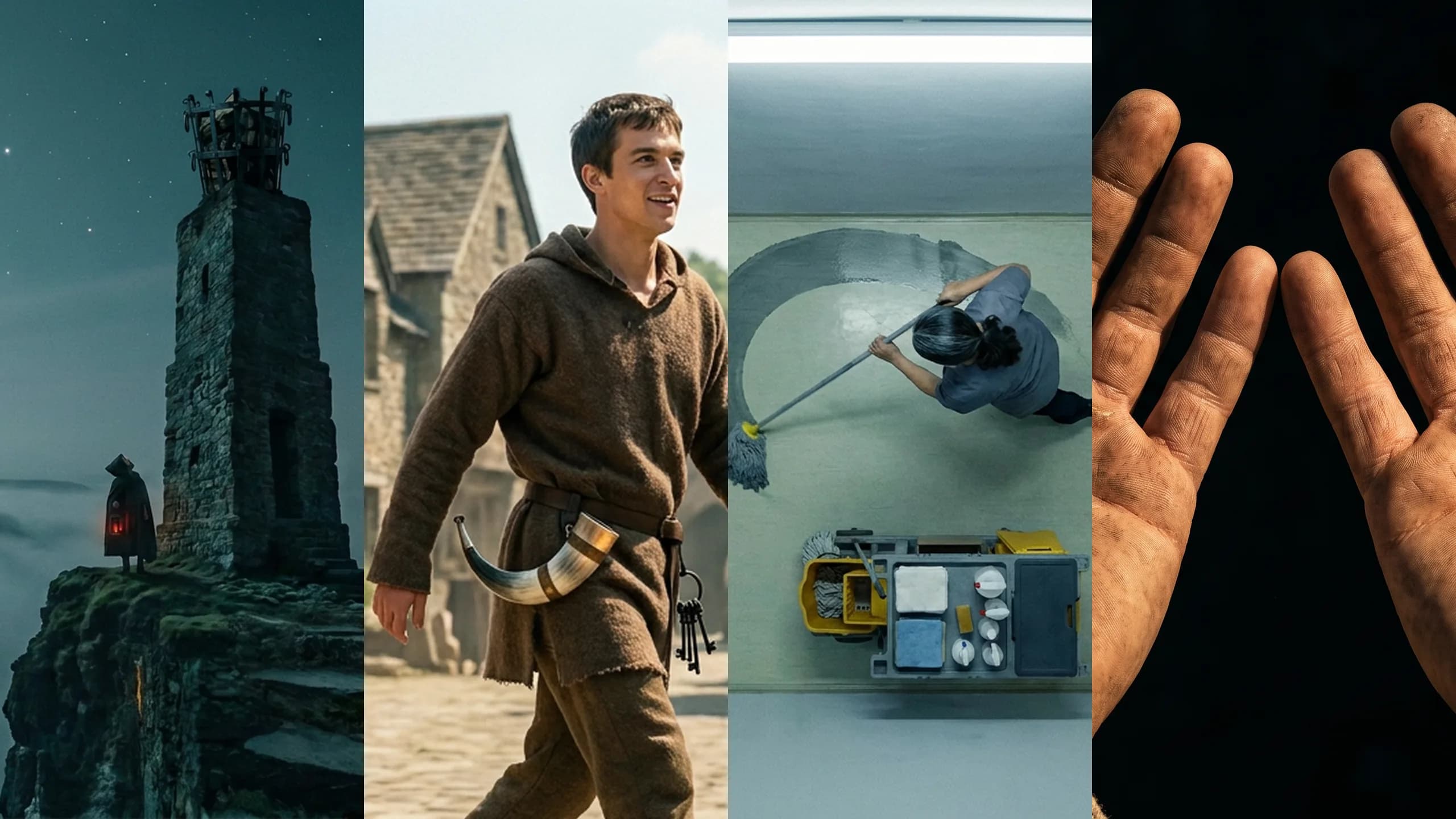
Essay · Responsibility
Four Faces of Responsibility
8 min read · Published 21 September 2026
Four tales from the same season, read together as one sequence: watching, handing on, carrying unseen, repairing.

Essay · Responsibility
What Money Can't Repair
6 min read · Published 6 September 2026
A ruined season, a fair offer of coins — and an old man's refusal that no purse, however honest, could answer.
Read the transcript
How much does a fault weigh?
One man in these hills could have told you — to the basket.
He carried the answer up his neighbor's path all one autumn, and it was the best of everything he had.
“The Debt of the Vineyard” A story about what coins cannot mend.
Come closer.
This one smells of crushed grapes and rain.
There was a hillside of vines, and a tenant on it named Noam a man with good hands and a daughter to be wed after the next harvest.
For the wedding he had set apart his oldest rows, the ones whose wine came dark and sweet.
He called them the wedding rows, and tended them like a second child.
In the evenings he ate bread and oil on his doorstep and counted the weeks to the wedding, the way a man counts money he has not yet been paid.
Between his hill and the next ran a hedge, and beyond the hedge lay old Boaz's vineyard the labor of one man's whole life.
In the hedge there was a gap.
The winter rains had opened it, and all spring Noam had meant to mend it.
Tomorrow, he told himself.
It was always a tomorrow-sized job.
On a grey morning in the season of new shoots, his goat pen stood open and empty.
He found them beyond the hedge, in Boaz's vines, in among the year's young growth and the young growth was gone.
Eaten to the stub, row after row of it, on the best slope the old man had.
A vine can lose its fruit and shrug.
It cannot lose its year.
He drove the goats home before the light was full.
And there, in the half-dark of his own yard, came the flicker every man knows: no one had seen.
The gap could be any beast's doing.
The goats were home.
He could simply — say nothing.
Noam stood in his yard while the sky lightened.
Then he crossed the hedge by the gap his own neglect had opened, and knocked on Boaz's door, and said the four heaviest words a man can carry uphill: "The goats were mine."
The old man's face closed like a gate.
By noon the village had the story, and by evening Noam's name walked ahead of him into every doorway the tenant who ruined Boaz's year.
He offered what he thought a fault costs.
Coins, counted out before the elders a fair price, he said, for the eaten fruit.
A kid from his flock besides.
Boaz let the coins lie.
"Fruit," the old man said.
"Can your coins prune?
Can they train a cane back to the stake?
I am seventy.
That was a year of my strength, and I do not have so many left that you can buy one."
The elders spoke the old law: when a man's beast strays into another's vineyard, he repays from the best of his own field.
The best not the equal.
And walking home, Noam argued with the dark.
The hedge was old.
The winter was hard.
Half of this was the rain's fault.
You have argued this way too, I think, on some walk of your own.
He stopped by his own oldest rows, and stood there a long time.
The best of his field was not a figure the elders had invented.
It hung in front of him the wedding rows, dark and heavy, a year of sweetness set apart for his daughter's table.
And he understood, standing there, what repair truly is.
Coins answer the fruit.
Only the best answers the year.
And even the best of his grapes could not drive a new stake, or prune the eaten rows back to good wood.
Money can close an account.
It cannot mend a vineyard.
Hands mend vineyards.
At harvest, the village watched Noam carry the wedding rows up Boaz's path, basket by basket, to the old man's press the best of everything he had, into another man's wine.
And that was only the first payment.
Through the autumn and the winter and into spring, he worked two vineyards: his own by day, and Boaz's in the dark before dawn pruning the ruined rows to the good wood, driving new stakes, carrying water up the slope on his shoulders.
He learned the old man's vineyard the way you learn a psalm — row by row, by heart.
His own harvest came in lean that year.
The wedding waited a year.
One cold morning, in a thin rain, he looked up from the staking, and old Boaz was kneeling in the mud beside him, saying nothing, working the next vine.
They finished the row together.
The next spring, the hedge stood mended along its whole length and in the middle of it, where the gap had been, there was something the hedge had never had before: a gate.
Noam's daughter was wed a year late, at a leaner table than her father had planned.
But Boaz came up the path carrying wine the wine pressed from the wedding rows and set it before her, and said: "Your father's grapes.
My press.
It is the best I have ever poured."
No coin in the valley could have bought what stood in that doorway.
He could have said nothing, that grey morning — kept his coins, his wine, and his tomorrow-sized job.
He would have kept everything, except his name, his neighbor, and the man he meant to be.
You have not owned a fault until you have paid for its repair.
If this stayed with you, there is another tale that answers it.
Go well.